Home › Care › Is an Owala dishwasher safe?
Is an Owala dishwasher safe?
Partly. Owala says all its lids are top-rack dishwasher safe and the straw can go in the silverware basket, but stainless steel bottle bodies are best washed by hand to protect the finish. Bottles made of Tritan plastic can go on the top rack. Carolina Arey, last reviewed September 30, 2026.
As an Amazon Associate we earn from qualifying purchases.
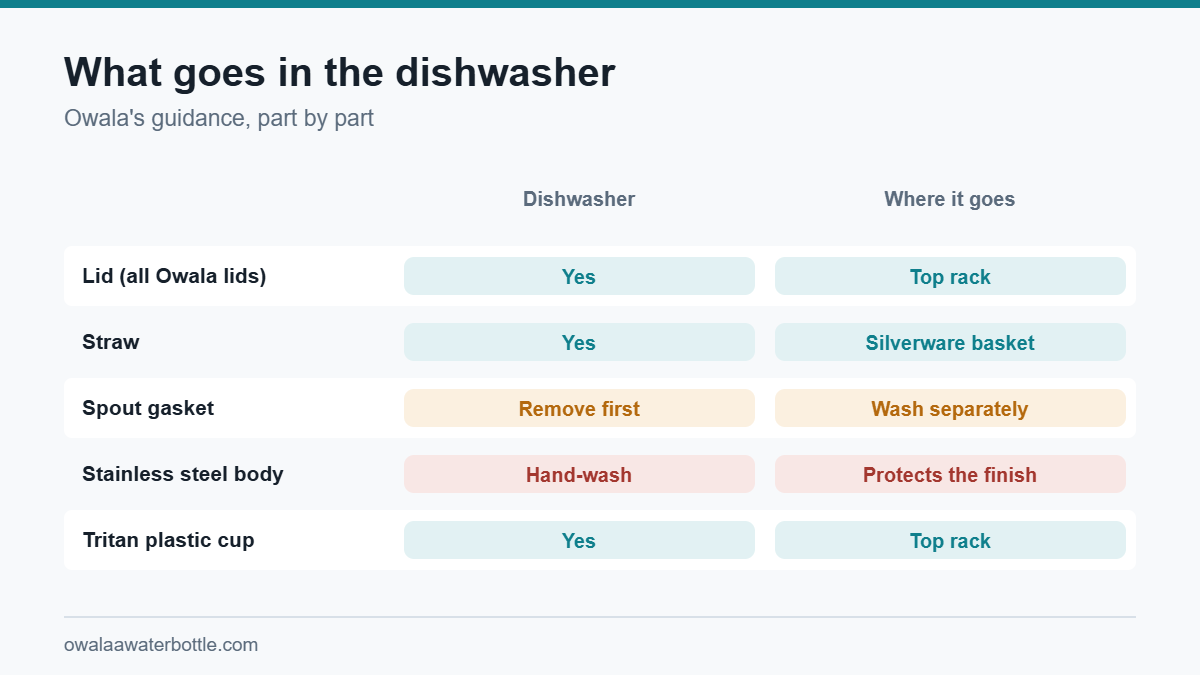
Dishwasher guide by part
| Part | Dishwasher? | Where |
|---|---|---|
| Lid (all Owala lids) | Yes | Top rack |
| Straw | Yes | Silverware basket |
| Spout gasket | Take it out first | Wash separately; Owala’s kids’ guide puts it in the utensil basket |
| Stainless steel bottle body | Hand-wash recommended | Technically safe, but Owala strongly recommends hand-washing |
| Tritan plastic cup | Yes | Top rack |
These rules come from Owala’s care instructions and FAQ. Because Owala says best practices can vary by part and model, check the care guide for your exact bottle.
Why the stainless steel body should be hand-washed
Owala recommends hand-washing the stainless steel cup with warm soapy water to protect the outer finish. Owala’s FAQ says the stainless steel cups are technically dishwasher safe, but it strongly recommends hand-washing them to keep the finish looking good.
How to put an Owala lid in the dishwasher
- Take the lid apart: straw out, gasket out with its pull tab.
- Place the lid on the top rack, facing down so water can drain from the spout.
- Put the straw in the silverware basket.
- Hand-wash the gasket, or put it in the utensil basket where it cannot slip out.
- Let all parts dry, then reassemble and check the gasket is seated.
Do not put the assembled lid in the dishwasher. The gasket seals water out, so a fully assembled lid will not get clean inside.
Does the dishwasher wear out the gasket?
Many owners report that repeated dishwasher cycles stiffen the gasket’s pull tab and can stop it from sitting flat, which then causes leaks. This is owner feedback, not an Owala statement, so treat it as a reason to check the gasket now and then, not a rule. If your lid starts to leak, see Why is my Owala leaking?
What not to do
- Do not microwave an Owala. Owala warns that heating a sealed bottle can build pressure and blow the lid open.
- Do not use bleach or abrasive cleaners.
- Do not rely on the dishwasher for a stainless steel body if you care about the finish, even though it is technically dishwasher safe.
Plastic Owala bottles: every part can go in
Owala’s FAQ treats plastic and steel differently. For bottles made of Eastman Tritan plastic, Owala says all parts are top-rack dishwasher safe. That covers the 25 oz Tritan FreeSip and the plastic Kids’ Tumbler cup. For stainless steel bottles, only the lid and straw are recommended for the dishwasher.
Printed and special-edition bottles
Retailers are stricter with printed designs. Urban Outfitters lists its exclusive printed FreeSip bottles with the cup as hand-wash only, not dishwasher safe. If your bottle has a print, a metallic finish or a custom engraving, hand-wash the cup to protect the artwork.
Pre-soak the gasket before a dishwasher cycle
A dishwasher rinses surfaces. It does not reach under a gasket that is still in place. Owala’s care guidance is to remove the spout gasket with its pull tab and clean it separately, and to soak parts in distilled white vinegar first to break up buildup. A short vinegar soak before the cycle gives a cleaner lid than the cycle alone.
Dishwasher or hand wash: which is better for the lid?
| Method | Good for | Limits |
|---|---|---|
| Top rack of the dishwasher | Sanitising the lid shell and straw with little effort | Does not clean under an assembled gasket; heat may wear the gasket over time, according to owner reports |
| Hand wash with a detail brush | Reaching the spout, straw port and gasket groove | Takes a few minutes; relies on drying properly |
The most thorough routine combines both: take the lid apart, brush the small spaces, then run the lid and straw on the top rack.
Settings that are kinder to the parts
- Use the top rack only, as Owala states for all lids.
- Put the straw in the silverware bin so it cannot fall onto the heating element.
- Put the gasket in a closed utensil compartment or wash it by hand.
- Let parts air dry fully before you rebuild the lid.
What the dishwasher will not fix
A dishwasher will not remove mold already growing under the gasket, will not restore a dented body, and will not remove a smell from a worn gasket. See Owala mold and smell.
FAQ
Can I put my Owala FreeSip in the dishwasher?
The lid and straw, yes. The stainless steel body, wash by hand. A plastic Tritan FreeSip can go on the top rack.
Are Owala Tumblers and SmoothSip lids dishwasher safe?
Owala says all its lids are top-rack safe. Check your model’s care guide for the body.
Can I put the straw in the dishwasher?
Yes, in the silverware basket.
Will the dishwasher damage the insulation?
Owala’s guidance about the finish is the reason to hand-wash. Wash the body by hand to be safe.
Is the plastic Owala FreeSip dishwasher safe?
Yes. Owala says all parts of its Eastman Tritan plastic bottles are top-rack dishwasher safe.
Can I put a printed or special-edition Owala in the dishwasher?
Hand-wash the cup. Retail listings for printed exclusive FreeSip bottles state the cup is hand-wash only.
Related guides: How to clean an Owala, How to clean an Owala lid and gasket, Owala mold and smell
Sources: Owala FAQ, Owala: how to clean the Kids’ FreeSip, Owala FreeSip usage and care instructions (manual copy), KENAS dishwasher guide, Owala FAQ, product care, Urban Outfitters printed FreeSip care notes
Next step: Owala replacement lid, Owala FreeSip review, Owala SmoothSip Slider