Home › FAQ › Is Owala safe? BPA, lead and materials
Is Owala safe? BPA, lead and materials
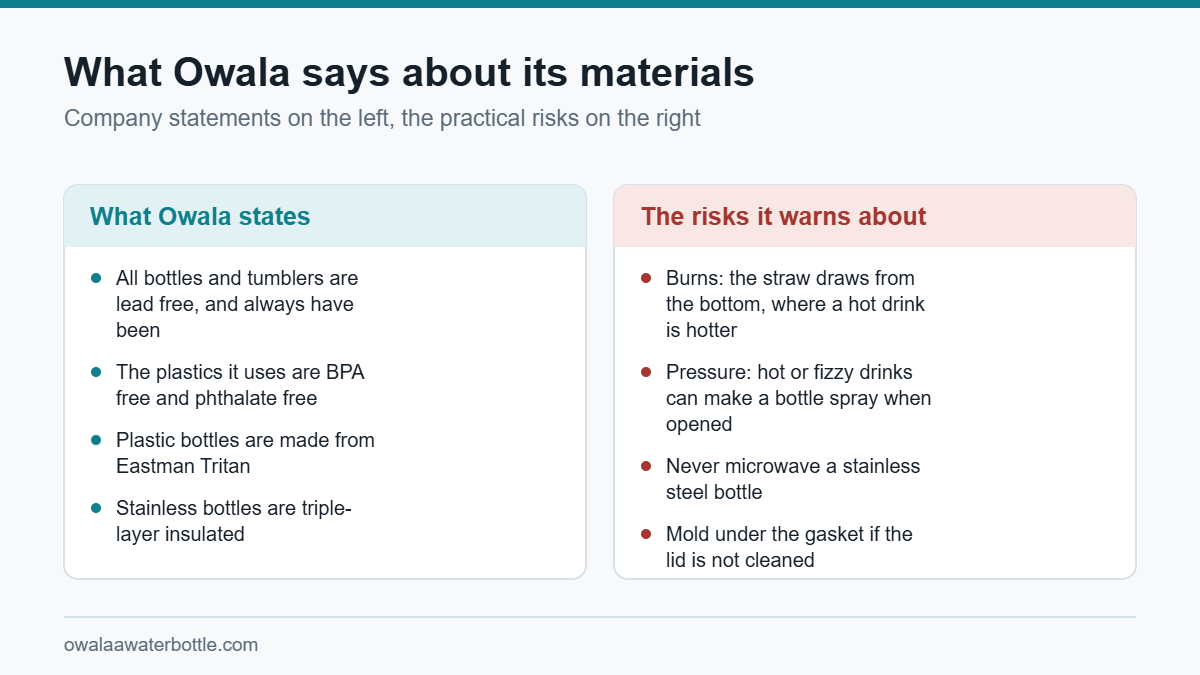
Owala says all its bottles and tumblers are and always have been lead free, and that its plastics are BPA and phthalate free. The safety risks it warns about most are practical ones: pressure from hot or fizzy drinks and burns from hot liquids. Carolina Arey, last reviewed September 30, 2026.
As an Amazon Associate we earn from qualifying purchases.
This page reports Owala’s own statements and cites them. We have not run lab tests on these bottles.
What Owala says about lead
Owala’s FAQ states that all its bottles and tumblers, including the FreeSip, are lead free and have been from the start. It says it used a lead-free solder in its products from the beginning. The statement was published as media attention on lead in tumblers grew, and Owala says it stands by its safety record. If lead is a concern for you, ask Owala for its test details; its FAQ says the bottles are tested and invites customers to contact it for details.
BPA, phthalates and plastic
| Material | What Owala says |
|---|---|
| Plastics used in Owala products | BPA free and phthalate free |
| Plastic bottles (Eastman Tritan) | Made from Tritan; not for hot, carbonated or perishable liquids |
| Stainless steel bottles | Triple-layer insulated stainless steel |
Sources: Owala FAQ and Owala FreeSip page. We could not find Owala publishing the exact stainless steel grade on the pages we read, so this guide does not state one.
Real safety risks and how to avoid them
- Burns. Owala warns that hot liquids can cause injury, and that the straw pulls liquid from the bottom, where a hot drink is hotter. Use hot drinks only in approved models, and never with scalding liquid. See Can you put hot drinks in an Owala?
- Pressure. Hot, carbonated and perishable drinks can build pressure that makes a bottle leak, spray or snap the spout cover open. Owala’s advice: open with caution and keep fingers away from the recess behind the spout cover.
- Microwaving. Owala says never to microwave stainless steel bottles and strongly discourages it for plastic ones.
- Dirty lids. Mold and residue collect under the spout gasket. Clean the lid regularly; see how to clean an Owala and Owala mold and smell.
- Accidental opening. Cover the button with the carry loop or lock so the lid does not open in a bag.
Is Owala safe for kids?
The Kids’ FreeSip follows the same rules as the FreeSip: Owala says not to use it for hot, carbonated or perishable liquids. Its lid has small parts, the straw and the gasket, so wash them daily or every couple of days and make sure a child cannot pull the gasket out. Owala’s kids’ cleaning guide calls the gasket a germ and mold trap if it is not cleaned often. For the model that fits your child, see Owala kids’ bottles.
Warranty and returns
Owala says it stands behind its bottles and takes warranty claims for manufacturing issues; it does not cover accidental damage, improper care or misuse, or normal wear and tear. Unused bottles in their original packaging can be returned for a refund within 30 days of purchase. See Owala warranty once that page is live.
What Owala says about lead, in its own words
Owala’s FAQ answers the lead question first. Its headline statement is “Owala Bottles Are Lead Free. Always Have Been. Always Will Be.” Owala explains that it has used a lead-free solder in its products from the very beginning, and that all its bottles and tumblers, including the FreeSip, are and always have been lead free.
Why lead became a question for insulated bottles
A vacuum-insulated bottle has two steel walls with the air removed from the gap between them. The gap has to be sealed at the base after the air is pumped out. In early 2024, news coverage reported that some tumbler makers seal that point with a pellet that contains lead, covered by a steel cap. Owala responded to that coverage by pointing to its lead-free solder. Business Insider reported that Owala and Hydro Flask both used the moment to stress that their bottles contain no lead.
Owala materials by part
| Part | Material, as described by Owala and retailers | Safety claim |
|---|---|---|
| Cup (insulated models) | Stainless steel, triple-layer insulated | Lead-free solder |
| Cup (plastic models) | Eastman Tritan plastic | BPA- and phthalate-free |
| Lid and cap | Plastic | BPA- and phthalate-free |
| Straw | Plastic | BPA- and phthalate-free |
| Spout gasket | Flexible removable seal | Clean separately; replace when worn |
Retail listings for the FreeSip repeat the same three claims: BPA-free, lead-free and phthalate-free.
Has Owala been tested?
Owala’s FAQ says its products are tested and invites customers to contact the company for details. Owala does not publish its lab reports on its website, so we cannot quote test figures here.
The safety warnings Owala prints
Material safety is one part of the picture. Owala’s usage guide lists the everyday risks:
- Do not microwave, freeze or boil the bottle.
- The standard FreeSip is not for hot, carbonated or perishable liquids.
- Pressure from altitude or heat can make the contents spray; loosen the lid a quarter turn first.
- Keep fingers away from the recess behind the spout cover when opening.
- Wash the bottle before the first use.
Hygiene is the larger day-to-day risk
For most owners the realistic safety issue is not the metal or plastic. It is a lid that has not been cleaned. Doctors quoted by Cleveland Clinic say unwashed bottles can grow bacteria and mold that cause stomach upset or allergy flare-ups. Follow How to clean an Owala lid weekly.
Is an Owala safe for children?
Owala recommends the Kids’ FreeSip for ages 3 and up and states the same BPA-, lead- and phthalate-free claims for it. Two points matter more for children: do not put hot drinks in it, and remove and wash the gasket often, because milk and juice residue spoil fast.
FAQ
Is Owala BPA free?
Owala says the plastics it uses are BPA and phthalate free.
Is Owala lead free?
Owala says yes, all bottles and tumblers, and that they always have been.
Are Owala bottles tested?
Owala’s FAQ says it would not sell untested products and invites customers to contact it for details.
Is Owala safe for hot drinks?
Only in the models Owala approves, and with care.
Is Owala safe to microwave?
No.
Does Owala use lead to seal its bottles?
No. Owala states that it has used a lead-free solder in its products from the beginning.
Does Owala publish its safety test results?
Not on its website. Owala’s FAQ says its products are tested and asks customers to contact the company for details.
Related guides: What can you put in an Owala?, Can you put hot drinks in an Owala?, Is an Owala dishwasher safe?, Why is my Owala leaking?
Sources: Owala FAQ, Owala FreeSip page, Owala: how to clean the Kids’ FreeSip, Owala FAQ: lead statement, Business Insider: Stanley lead coverage, Owala and Hydro Flask response, Owala FreeSip usage guide (PDF)
Next step: Owala Kids FreeSip, Where is Owala made?, What is Owala?